

Most companies think they understand user experience. They are wrong. They have been building digital products around assumptions, legacy frameworks, and the ghost of design thinking past, while the rules of UX have quietly, completely changed. By the time you finish this guide, you will know exactly why, and what to do about it.
Here is the uncomfortable truth: the $11.41 billion UX services market in 2025 is growing fast, yet only 1% of customers believe brands consistently meet their expectations. That gap is not a coincidence. It is the result of organizations treating user experience as a department rather than a discipline.
This guide covers everything from foundational definitions to the most disruptive UX forces reshaping products in 2026. Whether you run a startup in Austin or lead digital transformation for a UK enterprise, what follows is the most current, honest UX primer available today.
What Is User Experience? The Definition That Actually Holds Up
The 50-Word Definition Built for Featured Snippets and Real Understanding
User experience (UX) refers to the overall perception a person has when interacting with a product, service, or digital system. It encompasses usability, accessibility, emotional response, and perceived value. Good UX ensures interactions feel intuitive, efficient, and meaningful. Bad UX costs conversions, damages trust, and loses customers permanently.
That definition is clean. But it is also incomplete, which is the honest thing to admit upfront.
UX is not just about screens. It is not just about apps or websites. Don Norman, the man who coined the term in the early 1990s while working at Apple, described it as encompassing all aspects of a person’s interaction with a company, its services, and its products. That includes the packaging. The customer support call. The loading spinner. The error message nobody reads until they are furious.
UX vs. Usability vs. UI: Clearing Up the Confusion Once and for All
Here is where most introductory articles fail you. They use UX, UI, and usability interchangeably, and that laziness costs practitioners credibility and clarity.
Usability is a subset of UX. It asks: can someone complete a task efficiently and without errors? UX asks something broader: did that experience make them feel anything? Did it match their expectations, their context, their cognitive load at that moment?
UI (user interface) is the visual and interactive layer, the buttons, typography, layouts, animations. UI without user experience thinking is decoration. User experience without UI execution is theory.
| Concept | What It Asks | Who Owns It |
|---|---|---|
| Usability | Can users complete tasks? | UX Researchers, QA |
| UI Design | Does it look and feel right? | UI/Visual Designers |
| User Experience | Does the whole interaction work? | Everyone, actually |
So when a product manager says “we need better UX” and then sends a Figma mockup to the design team, they have already misunderstood what user experience means.
Why User Experience Is Now a Revenue Driver, Not a Cost Center
The ROI Numbers That Should End Every Budget Debate
Every $1 invested in UX design returns $100 in ROI, a 9,900% return, according to Forrester Research. That is not a typo.
A well-designed user interface can raise conversion rates by up to 200%. But that is the floor. A superior user experience design can yield conversion rate improvements of up to 400%, again per Forrester. And Baymard Institute found that simply optimizing checkout UX for large e-commerce sites boosts conversion rates by 35.26%, based on a decade of research across the world’s largest platforms.
Stop treating user experience as a line item. Start treating it as a multiplier.
The global UX services market was valued at $11.41 billion in 2025. It is expected to reach $13.06 billion in 2026, with a projected CAGR of 14.49% through 2031. That trajectory reflects what CFOs are beginning to understand: that friction in the user journey is a direct leak in the revenue funnel.
‘The companies that will win the next decade are the ones that make their products feel effortless. Effort is the enemy of loyalty.’
— Sundar Pichai, CEO, Google
The Expectation Gap That Is Destroying Brand Loyalty
Consider this: 86% of buyers are willing to pay more for a better customer experience. Yet only 1% of customers believe that vendors consistently meet their expectations. That is not a design problem. That is a strategic crisis.
US businesses and UK brands alike are pouring money into digital transformation, cloud infrastructure, and AI features, while the actual user experience those investments deliver continues to disappoint. Forrester’s Predictions 2026 report warns that CX teams face a critical turning point: tighter budgets, stagnant satisfaction scores, and an urgent need to connect user experience directly to business value rather than survey metrics.
Here is what that means practically: if your UX strategy still starts with wireframes and ends with launch, you are measuring the wrong thing. The question is not whether users can use your product. It is whether using your product makes them more likely to return, refer, and pay more.
Want to see how conversion-focused UX thinking applies to real sales outcomes? The 16 winning strategies to convert traffic into sales guide walks through exactly that intersection.
The Core Principles of Good User Experience Design
The Seven Pillars Most Teams Only Half-Understand
Nielsen Norman Group’s foundational framework defines good user experience across seven qualities: useful, usable, desirable, findable, accessible, credible, and valuable. These are not abstract ideals. They are diagnostic tools.
Most product teams obsess over usability and desirability. They A/B test button colors and agonize over micro-animations. But findability, the ease with which users locate what they need, gets ignored until the search data looks catastrophic. And credibility, the degree to which a product signals trustworthiness, is almost never measured until something goes viral for the wrong reasons.
Accessible design deserves special attention in 2026. Under EU accessibility regulations coming into force, neurodiversity-inclusive design is becoming a legal requirement, not a progressive bonus. Designing for autism spectrum conditions, ADHD, dyslexia, and other cognitive differences is no longer niche. It is the standard. Future Platforms identified neurodiversity-first design as one of the defining UX transformations businesses must act on now, calling it “Designing for the End of the Average User Myth.”
Human-Centered Design: What It Actually Demands
Human-centered design (HCD) is the process philosophy behind great UX. It demands that designers understand users before designing for them, test assumptions ruthlessly, and iterate based on real behavior rather than stakeholder opinion.
Imagine a mid-sized e-commerce brand in the North American market. Their cart abandonment rate was 74%. Their design team had rebuilt the checkout flow twice. Both times, they based decisions on what the product manager believed users wanted. Nobody had spoken to an actual user in eight months. A single round of usability testing with 12 participants revealed three critical friction points invisible in the analytics. One afternoon of research. Six figures in recovered annual revenue.
That is what human-centered design actually demands: humility, curiosity, and the discipline to test before shipping. Poor user experience is almost always a research failure before it is a design failure. For a deeper look at how this thinking applies to research methods, the 8 most explosive UX research trends covers where the field is heading fast.
The UX Design Process: From Discovery to Deployment
Step by Step, Without the Buzzword Fog
The UX design process is not linear. Anyone who presents it as a neat five-step waterfall has never shipped a product under real constraints. But there is a logical arc, and understanding it prevents the most expensive mistakes.
Discovery comes first. This means user research, stakeholder interviews, competitive analysis, and defining the problem worth solving. Skipping discovery is the single most common reason digital products fail quietly. They get built. They get shipped. Nobody uses them. Everyone is surprised.
Then comes definition: synthesizing research into personas, user journey maps, and clear problem statements. Then ideation. Then prototyping. Then testing. Then implementation. Then measurement and iteration. That last phase never actually ends.
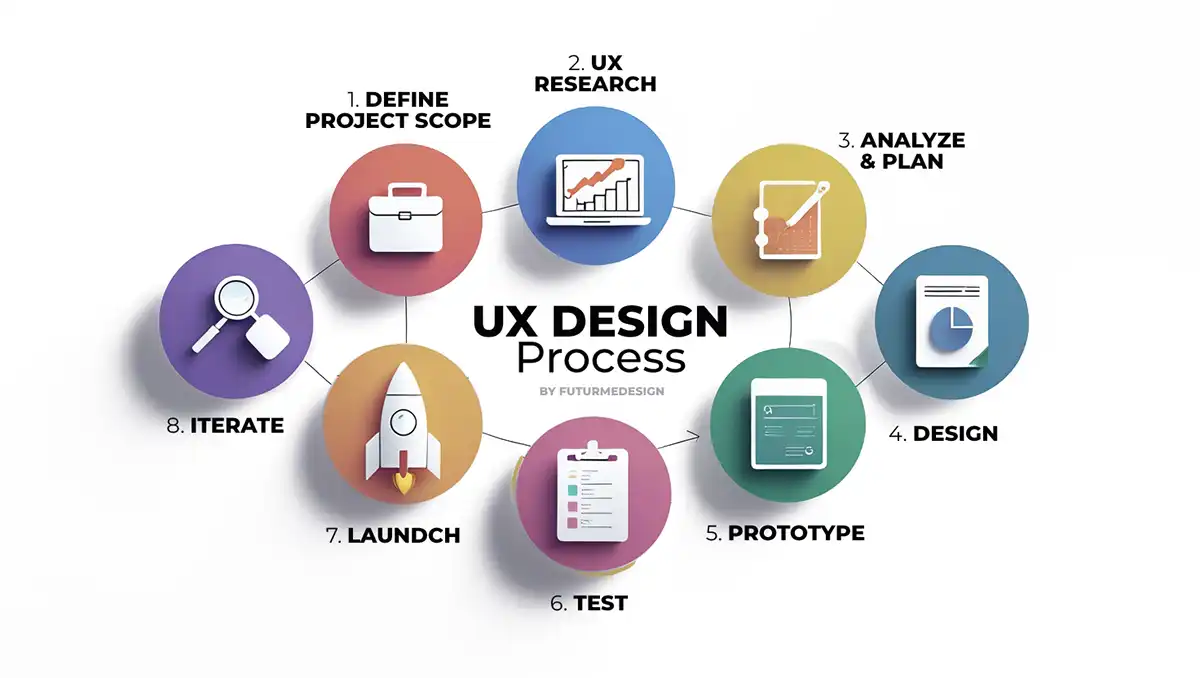
| Phase | Core Output | Fatal Mistake to Avoid |
|---|---|---|
| Discovery | Research insights, problem statement | Skipping it entirely |
| Definition | Personas, journey maps | Building fictional personas |
| Ideation | Concepts, wireframes | Falling in love with first idea |
| Prototyping | Interactive mockups | Over-polishing before testing |
| Testing | Validated insights | Testing with team members only |
| Iteration | Refined product | Treating launch as the finish line |
How to Measure User Experience Without Lying to Yourself
UX metrics fall into two categories: behavioral and attitudinal. Behavioral metrics, like task completion rates, time on task, error rates, and drop-off points, tell you what users do. Attitudinal metrics, like Net Promoter Score, System Usability Scale (SUS), and post-task satisfaction ratings, tell you what users feel.
The mistake most teams make is tracking only one type. Behavioral data without attitudinal context produces optimization theater. High task completion rates can coexist with deep user frustration. Attitudinal data without behavioral grounding produces opinion surveys that change nothing.
Use both. And tie both to business outcomes. A 12% improvement in SUS scores means nothing to a CFO. A 12% improvement in SUS scores correlated with a 19% reduction in support tickets does.
How AI Is Changing User Experience Design in 2026
AI Fatigue Is Real, and It Is a UX Crisis
Here is the thing nobody in the AI industry wants to say out loud: users are tired.
Nielsen Norman Group’s State of UX 2026 report declares 2026 the “year of AI fatigue.” Users and practitioners are burned out by AI being forced into every product interaction, from AI-generated search results to chatbots that cannot answer a simple billing question. Companies using AI thoughtfully and strategically will outperform those who add AI features reactively. That is not a prediction. It is already happening.
The UX implication is significant. Adding AI to a product does not automatically improve the user experience. In fact, the fastest way to damage user experience in 2026 is to automate interactions users want to control themselves. It can and regularly does degrade it, when the AI output is unpredictable, when it removes user control, or when it solves a problem the user did not have. The discipline of AI trust design, building transparency, explainability, and meaningful control into AI-powered products, is becoming a core UX competency.
Generative UI and Agentic Interfaces: The Next UX Frontier
Beyond AI fatigue lies something genuinely transformative. UX Tigers’ 2026 predictions identify accelerating AI capabilities as shifting UX focus from static interfaces to autonomous agents and Generative UI, making user experience “the primary business moat” as multimodal integration renders single-purpose tools obsolete.
Generative UI means interfaces that are not pre-designed but assembled dynamically in response to user context and intent. Agentic interfaces mean AI systems that act on behalf of users, navigating systems, completing tasks, and making decisions without step-by-step user instruction. Both of these developments do not replace UX design. They make it harder, more consequential, and more interesting.
Codewave’s 2026 UX Design Trends report signals that predictive interfaces, where the UI surfaces relevant features before the user explicitly asks, are becoming mainstream. Context-aware systems that adapt based on environment, location, and behavioral data are no longer experimental. They are shipping in production at scale.
For a deeper dive into where AI and design intersect, the guide on AI in design and how algorithms are redefining creativity explores this collision in detail. And if you want to understand the agent layer reshaping every digital touchpoint, AI agents: the edge your rivals hope you don’t discover is required reading.
Spatial Computing and AR: UX Beyond the Screen
The Apple Vision Pro and the broader push into spatial computing are forcing UX designers to rethink interaction paradigms developed over three decades of screen-based design. Depth, gesture, gaze, and voice are not new, but their combination at commercial scale is. Future Platforms flagged spatial and AR experiences as one of the defining UX transformations for 2026.
This does not mean every product needs an AR layer. It means the underlying principles of good UX, clarity, context, and control, need to be translated into entirely new interaction models. The teams who build that translation competency now will own the spatial interface patterns of the next decade.
UX Design Principles Every Practitioner and Business Leader Must Know
Hick’s Law, Fitts’s Law, and the Science Behind Intuition
Great UX is not decoration. It is applied cognitive science. And the most durable UX principles are grounded in how human perception and decision-making actually work.
Hick’s Law states that the time it takes to make a decision increases logarithmically with the number of available choices. That is why Amazon’s product recommendation algorithm is a UX tool, not just a revenue tool. Reducing decision complexity reduces cognitive load, which increases conversion. The best checkout flows in the world are the ones that feel almost too simple.
Fitts’s Law describes the relationship between target size, distance, and pointing time. Practically: make important interactive elements large enough to tap easily on mobile, and place them where thumbs naturally rest. This is why mobile navigation has migrated to the bottom of the screen. Physics and physiology, not aesthetic preference.
Jakob’s Law, from Jakob Nielsen himself, is perhaps the most underused: users spend most of their time on other sites. They expect your site to work the way other sites work. Radical UI innovation is rarely rewarded by users. Familiarity is a UX feature.
How the Best-in-Class Brands Apply These Principles
Nike’s digital ecosystem is a studied example of UX consistency at scale. From the Nike app to the in-store kiosk to the website checkout, the interaction language is identical. Transitions feel the same. Error states communicate the same way. A user who has only ever bought shoes on the app does not have to relearn anything when they encounter a new Nike digital touchpoint. That consistency is a UX strategy, not an accident.
Alinma Bank’s digital banking interface in Saudi Arabia took a radically different approach, redesigning for a right-to-left reading culture not as a mirror image of its Western equivalents but as a genuinely native experience. The result was measurably higher task completion rates among Arabic-speaking users. Cultural UX adaptation is not a localization checkbox. It is a business advantage.
Both examples point to the same principle: excellent user experience is the product of intentional, research-grounded decisions made consistently at every touchpoint. It does not happen by accident. And it cannot be outsourced to a design system without the strategic thinking to deploy it. For a broader view of how design intersects with brand, see branding as more than a logo: it is an emotion.
User Experience and SEO: The Connection Most Teams Miss
How Google Uses UX Signals to Rank Your Site
Google’s Core Web Vitals, Largest Contentful Paint, Interaction to Next Paint, and Cumulative Layout Shift, are UX metrics baked directly into search ranking. This is not a future development. It has been live for years, and most marketing teams still do not fully account for it.
But the connection goes deeper than technical performance. Dwell time, bounce rate, pogo-sticking behavior, the pattern of users clicking a result and immediately returning to search, are behavioral signals that tell Google whether your content delivered on its promise. A technically fast page with a confusing layout and irrelevant content will still underperform a slightly slower page that users actually read and engage with.
In 2026, with AI-driven search results reshaping how users interact with SERPs, the page-level user experience is more important than ever. Users who do reach your site have cleared a higher bar of intent. Disappointing them is more costly than it used to be. The traditional SEO is over guide explains how search behavior shifts are changing the entire optimization model.
Page Speed, Mobile UX, and the Metrics That Move Rankings
Mobile now accounts for the majority of web traffic across every major market, USA, UK, Canada, Australia. Yet the majority of mobile UX still underperforms desktop UX on the same properties. That gap is a ranking signal and a revenue leak.
A 1-second delay in mobile page load time can reduce conversions by up to 20%, according to Google’s own research data. And the Baymard Institute’s finding that checkout UX optimization drives a 35.26% conversion lift is almost entirely driven by mobile improvements. The return on mobile user experience investment is not incremental. It is transformational for most mid-market businesses.
How to Build a UX Strategy That Survives Org-Chart Politics
Why UX Keeps Getting Defunded and What to Do About It
UX has a positioning problem inside most organizations. It is perceived as a service function, a team you call when something looks broken or when the product is almost finished and needs “a UX pass.” That perception is a structural problem, and it is the reason UX investment cycles erratically through budget seasons.
The fix is not to lobby harder for user experience investment. It is to reframe the conversation entirely around business outcomes. Forrester’s 2026 CX warning is instructive here: teams that position user experience as a score-chasing exercise will face irrelevance. Teams that demonstrate a direct link between UX investments and revenue impact, customer lifetime value, support cost reduction, and referral rate, become untouchable in budget reviews.
Practically, this means embedding UX metrics into every product roadmap. Not as a separate workstream, but as a leading indicator for the KPIs the business already cares about. When the VP of Sales sees that a redesigned onboarding flow reduced time to first value by 40%, they become a UX advocate without being asked. That is the goal.
Building Internal UX Maturity: The Stages Organizations Actually Go Through
Most frameworks describe UX maturity as a linear progression from reactive to strategic. The reality is messier. Organizations frequently regress. A new CTO arrives with strong opinions about design. A recession hits and research budgets vanish first. A high-profile product success gets attributed to engineering rather than UX, and the lesson is learned in the wrong direction.
What separates organizations that sustain high user experience maturity from those that cycle between investment and neglect is usually one thing: executive sponsorship grounded in business literacy. When a C-suite leader genuinely understands that user experience is a revenue discipline, not a design discipline, UX teams get the access, budget, and organizational authority to do meaningful work.
The guide on human-centricity: key principles, uses, and future trends explores exactly how organizations build this kind of strategic design thinking at the institutional level.
UX Design Tools, Methods, and Career Paths in 2026
The Tool Stack That Actually Gets Work Done
Figma remains the dominant collaborative design tool for user experience work in 2026. But the stack around it has evolved considerably. Research teams are increasingly using AI-assisted synthesis tools to process large volumes of qualitative data faster. Maze, UserTesting, and Hotjar have all added AI layers to their analysis pipelines. The risk, worth naming directly, is that AI-assisted research synthesis can amplify researcher bias at scale if the underlying data collection was flawed.
Prototyping tools have bifurcated. High-fidelity interactive prototypes in Figma or Protopie for stakeholder alignment and usability testing on one side. Low-fidelity paper and whiteboard sketching for early ideation on the other. The mistake is using high-fidelity tools for early exploration, which anchors teams to the first idea that looks polished enough to present.
What Skills a UX Designer Actually Needs in 2026
The question of what makes a strong UX designer has shifted meaningfully in the last two years. Research proficiency remains foundational. Systems thinking, the ability to design experiences that work coherently across touchpoints and states, has become a differentiator. And AI literacy, understanding enough about how AI systems behave to design experiences around them rather than despite them, is now a practical requirement in most product environments.
Soft skills matter more than they used to. Facilitation, stakeholder communication, and the ability to translate user research into language that resonates with product and engineering teams, those capabilities determine whether a UX designer influences outcomes or just produces deliverables. The article on whether AI will replace designers addresses the automation question honestly, without the usual hand-waving in either direction.
‘AI won’t replace designers. But designers who use AI will replace those who don’t.’
— Jensen Huang, CEO, NVIDIA
The UX job market contracted sharply through 2023 and into 2024. Recovery has been uneven, stronger in product companies, weaker in agencies, and concentrated in practitioners who can demonstrate quantifiable business impact rather than just craft quality. Portfolios that lead with outcomes, not aesthetics, are winning the roles that matter.
Conclusion: User Experience in 2026 Is Everyone’s Job
We promised at the start of this guide to resolve an uncomfortable truth. Here it is: the brands winning on user experience in 2026 are not the ones with the best design teams. They are the ones where the entire organization, from engineering to finance to customer support, understands that every touchpoint shapes user experience and every user experience decision is a business outcome.
AI fatigue, neurodiversity mandates, agentic interfaces, spatial computing, and the death of UI as a differentiator are not future challenges. They are present ones. The UX practitioners and business leaders who respond to them with rigor, empathy, and commercial clarity will build the products people actually choose to use.
And the ones who keep treating UX as a design department? They will keep wondering why their conversion rates plateau and their NPS scores drift sideways.
Start with one honest question: does your organization measure user experience in a way that a CFO would care about? If the answer is no, that is where to begin. Everything else, the tools, the research methods, the design systems, flows from that foundation.
Your UX is losing revenue. Let’s find out exactly where.
FuturmeDesign is an AI-powered digital agency built by highly qualified engineers, continuously certified by IBM, Google and AWS across AI, cloud, analytics, performance marketing and conversion optimization (2026). Since 2007, we have helped brands of all sizes dominate their markets. From $100 micro-projects to enterprise transformations, premium digital expertise for everyone. Discover our story and get a free audit today.
Frequently Asked Questions About User Experience
What is user experience (UX) and why does it matter?
User experience (UX) is the overall perception someone has when interacting with a product, service, or system. It covers usability, accessibility, emotional response, and value. It matters because poor UX drives customers away permanently, while excellent UX increases conversions, loyalty, and willingness to pay more.
What is the difference between user experience (UX) and user interface (UI)?
UI (user interface) is the visual and interactive layer of a product: buttons, layouts, typography. UX encompasses the entire experience, including how it feels, how well it meets user goals, and how it performs across every touchpoint. UI is one component of UX, not a synonym for it.
How do you measure user experience?
UX is measured through behavioral metrics (task completion rate, time on task, error rate, drop-off) and attitudinal metrics (NPS, System Usability Scale, post-task satisfaction). The most effective UX measurement programs combine both and tie results directly to business outcomes like conversion rate and support cost.
What are the key principles of good user experience design?
Good UX design is useful, usable, desirable, findable, accessible, credible, and valuable, per Nielsen Norman Group’s framework. Practically, this means designing for real user mental models, reducing cognitive load, maintaining consistency across touchpoints, and testing assumptions with real users before and after launch.
What is the UX design process step by step?
The UX design process moves through discovery (research and problem definition), definition (personas and journey maps), ideation (concepts and wireframes), prototyping, user testing, implementation, and continuous iteration. It is not linear. Real projects cycle through these phases multiple times as new insights emerge.
How does user experience affect SEO rankings?
Google’s Core Web Vitals (LCP, INP, CLS) are UX metrics baked directly into search ranking algorithms. Beyond technical scores, behavioral signals like dwell time, bounce rate, and pogo-sticking indicate whether users found your page valuable. Poor UX lowers rankings; strong UX reinforces them through genuine user engagement.
What skills does a UX designer need?
Core UX designer skills in 2026 include user research methods, systems thinking, prototyping, data analysis, and AI literacy. Equally important are soft skills: stakeholder facilitation, translating research into business language, and communicating design decisions to engineering teams. Practitioners who demonstrate business impact win the best roles.
What is the ROI of investing in user experience?
Forrester Research calculates that every $1 invested in UX returns $100, a 9,900% ROI. UX improvements can raise conversion rates by up to 400%. Checkout UX optimization alone lifts e-commerce conversion by 35.26% on average. These returns make UX one of the highest-ROI investments available to digital businesses.
How is AI changing user experience design in 2025?
AI is transforming UX through predictive interfaces, agentic systems, and Generative UI. But it is also creating AI fatigue: users pushed past tolerance by forced AI integrations. Successful UX in 2025 and 2026 requires designing AI that is transparent, controllable, and genuinely useful rather than technically impressive and practically frustrating.
What are the most important user experience trends for 2026?
The top UX trends for 2026 are AI fatigue management, neurodiversity-first design, agentic and Generative UI, spatial computing and AR experiences, predictive interfaces, and AI trust design. The unifying theme: user experience is becoming the primary competitive differentiator as feature parity makes everything else commoditized.
References
Nielsen Norman Group -- Definition of User Experience (2026)
Nielsen Norman Group -- State of UX 2026 (January 2026)
Forrester -- Predictions 2026: Customer Experience (October 2025)
UX Tigers -- 2026 UX Predictions (January 2026)
Future Platforms -- 10 Key UX Trends for 2026 (August 2025)
Codewave -- UX Design Trends 2026 (January 2026)
HatchWorks -- User Experience Statistics (August 2025)
Userpilot -- UX Statistics (October 2025)
UXtweak -- UX Statistics and Benchmarks (January 2026)
Glorium Tech -- UX Services Market Research (March 2026)
Interaction Design Foundation -- UX Design Overview (2026)


