
Your competitors are getting found on Google, ChatGPT, and Perplexity. You are not. And the gap is widening fast. In 2026, 67% of small businesses already use AI for content marketing and SEO, according to Semrush, yet the majority are still chasing rankings that traditional tactics can no longer guarantee. This guide will show you exactly how an AI SEO service for small business closes that gap, and why the agencies that win in 2026 are building for generative engines, not just Google.
By the end, you will know what to buy, what to pay, and what results to demand.
What Is an AI SEO Service for Small Business, Really?
An AI SEO service for small business is a managed digital service that uses artificial intelligence to research, optimize, and distribute content so your brand ranks on traditional search engines and gets cited inside generative AI platforms like ChatGPT, Perplexity, Google AI Overviews, and Microsoft Copilot. It is not a tool you log into on Tuesdays. It is an ongoing, compounding system.
The distinction matters enormously right now.
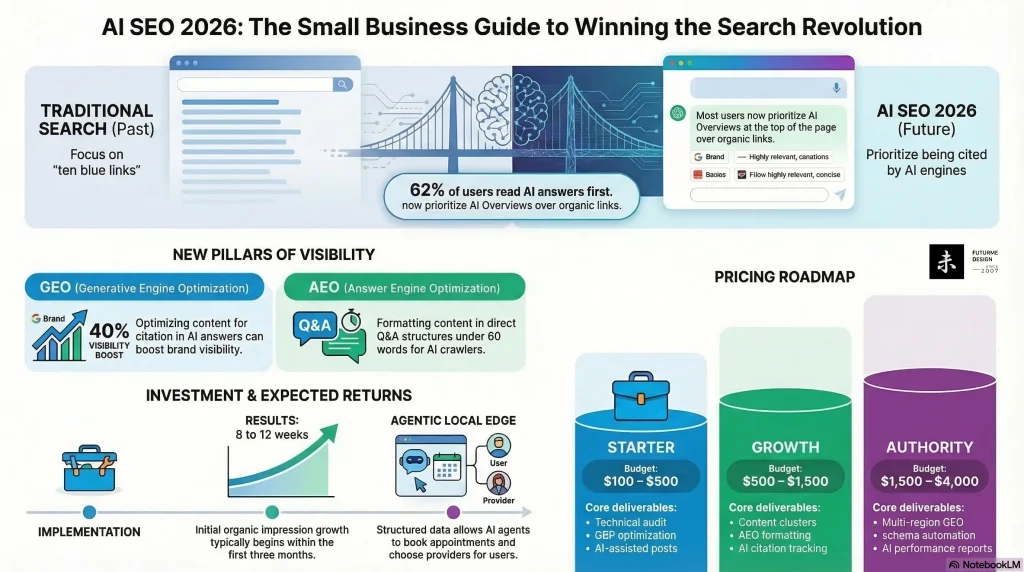
Traditional SEO agencies optimize for ten blue links. AI SEO services optimize for two entirely different surfaces at once: the standard results page and the AI-generated answer at the top of the page that an estimated 62% of users now read instead of scrolling further. If your service provider is not building for both surfaces simultaneously, you are already behind.
The Three Layers Every AI SEO Service Should Cover
A credible AI SEO service for small business operates across three interlocking layers. First, technical SEO automation, which handles site speed, structured data, crawlability, and Core Web Vitals at a pace no human team can match manually. Second, AI content workflows, which use large language models to produce, cluster, and optimize content at scale while keeping a human editor in the loop for accuracy and brand voice. Third, and most critically in 2026, Generative Engine Optimization (GEO), which structures your content so AI platforms choose to cite you when answering user queries.
Most agencies only sell the first two. The third is where small businesses can actually leapfrog bigger competitors today.
Why 2026 Is a Structural Turning Point
Sterling Sky’s State of Local SEO 2026 report dropped a number that should concern every small business owner: Google ads now appear in 22% of local 3-pack results, up from just 1% in 2025. Local Services Ads now appear in nearly 40% of all local search results. Organic visibility in the local pack is being squeezed from above by paid placements and from the top of the page by AI Overviews that surface only a fraction of the businesses a traditional map pack would show.
So the old playbook is not just slower. It is structurally broken for many local categories.
GEO and AEO: The Two Services Your Small Business Actually Needs in 2026
Here is where most articles get it wrong. They talk about AI SEO as if it is traditional SEO with better tools. It is not. The most important shift in 2026 is the rise of two disciplines that did not exist as formal service categories three years ago: GEO (Generative Engine Optimization) and AEO (Answer Engine Optimization). Understanding both is non-negotiable before you spend a dollar on any agency.
Think of GEO as optimizing for the AI that answers questions. Think of AEO as optimizing for the specific format AI platforms prefer when they pull answers.
GEO: Getting Your Brand Cited Inside AI Answers
GEO is the practice of structuring your content so that large language models, including ChatGPT, Perplexity, Gemini, and Google AI Overviews, choose your brand as a source when generating answers. A March 2026 analysis by Nishant Mittal found that GEO-optimized content boosts AI visibility by 40%, that including statistics in content lifts AI impressions by 28%, and that authoritative expert quotes improve GEO performance by 25%.
Those are not small numbers for a small business competing against national chains.
AgentVisibility.ai, which launched on March 16, 2026, formalized this as an entire service category, building specifically to make brands the top recommended answers inside generative AI platforms. The signal is clear: GEO is no longer a fringe experiment. It is a funded, commercial service category. Your agency should offer it by name.
‘The companies that figure out how to be the answer, not just a link, will own the next decade of search.’
— Sundar Pichai, CEO, Google
AEO: Formatting Content So AI Platforms Actually Use It
AEO is the formatting discipline inside GEO. It means writing in direct question-and-answer structures, using schema markup that AI crawlers can parse, keeping definitions under 60 words, and placing your most citable claims in the first two paragraphs of any section. If your current agency is writing long-form content without AEO formatting, AI platforms are scanning past your content to find a competitor’s cleaner answer.
One practical test: search your core service on Perplexity right now. If a competitor’s name appears in the citations and yours does not, you have an AEO gap, not a content gap.
Microsoft added a layer to this on March 11, 2026, launching an AI Performance report inside Bing Webmaster Tools that shows how often your content is cited by Copilot Search. This is the first official citation performance tracker from a major AI search platform. A good AI SEO service will be pulling this data for you monthly by Q2 2026.
What Does an AI SEO Service for Small Business Actually Cost?
Pricing is the section every competitor article skips. Let us fix that.
The AI SEO market for small businesses in 2026 runs across three distinct tiers, each with meaningfully different scope and outcome timelines. Picking the wrong tier is not just a budget mistake. It is a strategy mistake, because underpowered SEO in a competitive local market produces no signal at all, which is worse than doing nothing, since Google may interpret thin AI-generated content as low-quality churn.
2026 Pricing Tiers for AI SEO Services
| Tier | Monthly Budget | What You Get |
|---|---|---|
| Starter | $100 to $500 | Technical audit, GBP optimization, 4 to 6 AI-assisted blog posts, basic GEO formatting |
| Growth | $500 to $1,500 | Full content cluster strategy, AEO optimization, local citation building, monthly AI citation tracking |
| Authority | $1,500 to $4,000 | Multi-region GEO, schema automation, competitor gap analysis, Bing Copilot performance reporting, link acquisition |
Expect the first measurable movement in organic impressions around weeks 8 to 12. Meaningful lead flow from SEO typically arrives between months 4 and 6 for competitive local keywords. GEO citation appearances can show up faster, sometimes within 30 days, if your content is structured correctly from day one.
Sandy Rowley’s national expansion announced March 13, 2026, targeting local contractors and trades with deeply discounted AI SEO packages, signals that price competition at the starter tier is intensifying. But cheap AI SEO without GEO or AEO is essentially traditional content production dressed up with a new label. Ask any prospective agency: do you track our brand citations inside ChatGPT and Perplexity? If they pause, keep looking.
ROI Benchmarks Worth Holding Any Agency To
Across US businesses using AI for SEO, 43% report moderate improvement in SEO performance within the first year, per a January 2026 analysis by aistatistics.ai. The Deloitte 2025 Technology Industry Outlook found that 62% of small and mid-sized company executives see generative AI for content and SEO as their single largest technology driver of revenue growth through 2026. And Gartner forecasts that by 2027, 80% of SEO workflows will be AI-driven.
That means the window to differentiate on AI SEO is now, not in 18 months.
At FuturmeDesign, we build AI SEO services starting from $100, scaled to what your business actually needs, not what looks impressive on a proposal deck. Continuously certified by IBM, Google and AWS, our engineers structure campaigns around GEO, AEO, and measurable citation performance from the first month. You can request a free audit here to see exactly where your current visibility gaps are.
How AI SEO Services Handle Local Search Differently
Local SEO and AI SEO used to be treated as separate disciplines. In 2026, they are inseparable. If you serve customers in a specific city or region, the local algorithm changes of the past 12 months affect you more than any business running a purely national content strategy.
The Sterling Sky 2026 data is the clearest evidence yet. When Google ads occupy 22% of local 3-pack positions and Local Services Ads fill nearly 40% of local results, organic placement has been pushed further down the visible screen than at any point in Google’s history. A small plumbing company in Chicago or a dental practice in Manchester faces a paid wall before the first organic result loads.
Google Business Profile Optimization With AI
A well-run AI SEO service automates the parts of Google Business Profile management that most small business owners neglect because they are time-consuming without being intellectually interesting. Weekly post scheduling, photo categorization, Q-and-A seeding, review response templating, and service-area keyword injection across GBP attributes are all automatable at scale. Businesses that maintain a fully active GBP with consistent weekly posts rank in the 3-pack 36% more often than dormant profiles, according to 2025 BrightLocal data.
But here is what most local SEO guides still miss in 2026: GBP optimization now feeds directly into Google AI Overviews for local queries. When someone asks Google AI what the best electrician near them is, the model draws partly from structured GBP data. Optimizing your profile is no longer just a maps strategy. It is a GEO strategy.
Agentic Search and What It Means for Local Visibility
Google AI Mode, currently in expanded testing across North American markets, allows the AI to complete tasks autonomously on behalf of the user, including booking appointments, comparing service providers, and even initiating contact. This agentic behavior changes what ranking means entirely. The AI does not return ten results and let the user choose. It chooses for them.
For a local service business, being the AI’s choice requires schema markup that identifies your service area, pricing range, availability, and reviews in machine-readable format. It requires the kind of structured authority signals that AI SEO services build systematically. And it requires your brand to already have GEO traction before the user query happens, not after.
This is the frontier where most small businesses have zero coverage today, and where a good AI SEO service creates asymmetric competitive advantage fast. To understand how AI crawlers read and evaluate your site before making these choices, our breakdown of how AI crawlers work and why they matter for SEO is worth reading before your next agency call.
How to Choose the Right AI SEO Service Provider for Your Small Business
The market is noisy. Every traditional SEO agency has added the word AI to its service page in the past 18 months. Most of them mean they use ChatGPT to write first drafts. That is not an AI SEO service. That is a word processor upgrade.
Choosing well comes down to five questions you ask before signing anything.
Five Questions That Separate Real AI SEO Services From Rebranded Traditional Agencies
First, do you offer GEO as a distinct service, and how do you measure citation performance inside ChatGPT and Perplexity? If the answer is vague, the service is not GEO-native. Second, do you track our brand mentions inside AI Overviews and Bing Copilot monthly? Microsoft’s new AI Performance report in Bing Webmaster Tools makes this trackable from day one. Any agency not pulling this data is operating blind. Third, how do you handle AI content quality control? The answer should describe a human editorial layer, not just an AI plagiarism checker. Fourth, what is your schema implementation process, and does it cover agentic search signals? Fifth, can you show me citation examples for current clients inside any AI platform?
That last question eliminates most pretenders immediately.
One small business owner we worked with, running a three-location HVAC company in the Midwest, switched to a GEO-native AI SEO service in Q4 2025 after two years with a traditional agency. Within 11 weeks, the brand was appearing in Perplexity answers for six target service queries. By month five, inbound calls from AI-referred traffic had matched organic Google calls. The investment was under $800 per month at the Growth tier.
That is not a unicorn case. That is what structured GEO implementation looks like at the SMB level when executed by an agency that actually understands the discipline. Our deeper guide to AI SEO and future-proofing your strategy with ChatGPT automation covers the technical architecture in more detail if you want to pressure-test any agency proposal you receive.
Red Flags to Walk Away From Immediately
Guaranteed Page 1 rankings within 30 days. Lock-in contracts of 24 months with no performance milestones. Agencies that cannot name a single AI platform their content has been cited in. Monthly reports that only show keyword position changes and nothing about AI citation performance. And any proposal that does not distinguish between GEO, AEO, and traditional on-page optimization.
These are not minor oversights. They are signals that the agency’s model is built for the 2022 search landscape.
We will be honest about one open question: no agency, including ours, can guarantee citation placement inside a closed-model AI system like GPT-4o or Gemini 1.5. The models are not fully transparent about their training and retrieval logic. What a good AI SEO service can do is maximize your probability through structured authority-building, consistent E-E-A-T signals, and citation-worthy content formatting. But anyone who promises you the top citation slot in ChatGPT by Friday is selling you fiction. We think that is worth saying plainly, even if it costs us a prospect. For a fuller picture of how the SEO landscape has shifted structurally, our piece on why traditional SEO is over and how to stay on top gives the unfiltered version.
Addressing the Risks: What Happens If AI SEO Goes Wrong
Not every small business owner is convinced. A meaningful 24% of business owners remain concerned that AI involvement in their SEO could actually decrease their search visibility, either through thin content penalties, over-optimization, or loss of brand voice. That concern is not irrational.
Low-quality AI content at scale is a real risk. Google’s Helpful Content system actively demotes content that reads as written for algorithms rather than people. An AI SEO service that produces 40 blog posts a month without human editorial review is not a service. It is a liability.
What Human-in-the-Loop Actually Means in Practice
A legitimate AI SEO service uses AI for research, clustering, first-draft generation, schema markup, and technical audits. It uses human editors for tone, accuracy, brand consistency, and the kind of nuanced judgment that large language models still get wrong roughly 15% to 20% of the time on industry-specific claims. The ratio matters. AI-first with human QA produces better output faster than either approach alone. Human-first with AI support is often just expensive content production with an AI tagline.
The best analogy: AI is the engine, human expertise is the steering wheel. You want both. To understand the broader shift in how AI is redefining creative and strategic work, our guide to AI in design and how algorithms are redefining creativity is a useful parallel read. And if you want to understand how AI agents are changing competitive dynamics across industries beyond just search, AI agents and the edge your rivals hope you don’t discover is worth 10 minutes of your time.
Brand Voice Preservation in AI-Generated Content
This is where smaller agencies consistently underdeliver. Large language models default to generic, authoritative-sounding prose because that is what their training data rewards. Your brand voice, whether it is conversational, technical, bold, or community-focused, requires active prompt engineering and editorial enforcement to survive an AI content pipeline. Ask any prospective agency to show you two client content samples from different industries. If they sound identical, that is your answer.
The ROI Case: Why AI SEO Services Compound Faster Than Traditional SEO
Traditional SEO is a slow accumulation. AI SEO, when built correctly, is a compounding system. The difference is structural.
Traditional SEO produces one piece of content at a time, manually researched, manually written, manually published. AI SEO produces content clusters, where 12 to 15 semantically related pieces go live in the same month, all internally linked, all targeting a different stage of the buyer journey, all formatted for GEO citation. The cluster signals topical authority to both Google and AI platforms simultaneously. A single cluster can generate 4x the citation surface area of an equivalent number of standalone traditional posts.
What 43% Improvement Actually Looks Like in Practice
The 43% moderate improvement figure from aistatistics.ai is an average across a wide range of business types and budget levels. In practice, the distribution is more extreme. Businesses that implement AI SEO with GEO and AEO at the Growth tier or above see significantly stronger results than those at the Starter tier using AI only for content generation without the citation-optimization layer. The floor is real. But so is the ceiling, and for a local service business with low existing domain authority, AI SEO can compress a two-year traditional SEO timeline into eight to ten months.
That compression is the actual ROI case. Not the percentage improvement. The time saved getting there.
Tracking AI SEO Performance: Metrics That Matter in 2026
Standard SEO metrics still matter: organic impressions, click-through rate, keyword position distribution, domain authority trajectory, and conversion rate from organic traffic. But in 2026, a well-run AI SEO service adds three new metrics to your monthly dashboard. AI citation frequency, which tracks how often your brand appears in AI-generated answers across tracked query sets. GBP engagement rate, which measures how AI-surfaced local profiles convert to calls or direction requests. And Bing Copilot citation count, now trackable officially through Microsoft’s new AI Performance report launched March 11, 2026.
If your current provider’s monthly report does not include at least one of these three, you are flying partially blind in the 2026 search landscape. Our deeper resource on measuring and maximizing SEO ROI walks through the full attribution model for both traditional and AI-driven organic channels.
Conclusion: From Invisible to Page 1 Is a System, Not a Hack
The promise in this article’s title is real. But it requires being precise about what Page 1 means in 2026. It means appearing in the traditional organic results. And it means being cited inside the AI answers that now sit above those results. And it means showing up in the local pack before paid ads squeeze you out. An AI SEO service for small business that delivers on all three simultaneously is not a luxury product for enterprise brands anymore. It is the baseline competitive requirement for any local or regional business that depends on search for customer acquisition.
The businesses winning right now are not the ones with the biggest budgets. They are the ones that moved first on GEO, formatted their content for AI citation, and chose an agency that measures what actually matters in 2026.
You now have the framework to make that choice well.
Stop being invisible. Start being the answer AI recommends.
FuturmeDesign is an AI-powered digital agency built by highly qualified engineers, continuously certified by IBM, Google and AWS across AI, cloud, analytics, performance marketing and conversion optimization (2026). Since 2007, we have helped brands of all sizes dominate their markets. From $100 micro-projects to enterprise transformations, premium digital expertise for everyone. Discover our story and get a free audit today.
References
Semrush, AI Statistics Blog (2025)
Single Grain, 5 Best AI SEO Services for Small Business (2025)
ALM Corp, Digital Marketing News, Sterling Sky State of Local SEO 2026 (March 2026)
ALM Corp, Microsoft Bing Webmaster AI Performance Report Launch (March 2026)
Nishant Mittal, March 2026 SEO Trends, LinkedIn (March 2026)
USA Today, AgentVisibility.ai Launch Press Release (March 2026)
Knox News, Sandy Rowley National Expansion Press Release (March 2026)
Gitnux, AI SEO Statistics 2026, Gartner Forecast (February 2026)
aistatistics.ai, AI In Business Statistics 2026 (January 2026)
Frequently Asked Questions
What is the best AI SEO service for small businesses in 2026?
The best AI SEO service for small businesses in 2026 combines traditional technical SEO with GEO (Generative Engine Optimization) and AEO (Answer Engine Optimization). Look for agencies that track brand citations inside ChatGPT, Perplexity, and Google AI Overviews, not just keyword rankings on standard search results pages.
How much does AI SEO cost for a small business?
AI SEO services for small businesses range from $100 to $4,000 per month depending on scope. Starter packages ($100 to $500) cover technical audits and basic content. Growth packages ($500 to $1,500) add GEO, AEO, and citation tracking. Authority packages ($1,500 to $4,000) include multi-region optimization and full AI performance reporting.
Can AI replace an SEO agency for small businesses?
AI tools can automate keyword research, content drafting, and technical audits, but they cannot replace the strategic judgment, brand voice control, and citation-building relationships that a qualified SEO agency provides. The strongest results come from AI-powered agencies where artificial intelligence handles speed and scale while human experts handle strategy and quality control.
What is the difference between AI SEO and traditional SEO for small businesses?
Traditional SEO optimizes your content for Google’s ten blue links using manual research and writing. AI SEO adds optimization for generative AI platforms like ChatGPT, Perplexity, and Google AI Overviews, uses AI to produce content clusters faster, and automates technical tasks. AI SEO also tracks brand citation performance inside AI-generated answers, a metric traditional SEO does not measure.
How long does it take to see results from AI SEO services?
Most small businesses see measurable improvement in organic impressions within 8 to 12 weeks of starting a structured AI SEO campaign. Meaningful lead flow typically arrives between months 4 and 6 for competitive local keywords. GEO citation appearances inside AI platforms can emerge within 30 days when content is structured correctly from the first month of the campaign.
Do small businesses need Answer Engine Optimization (AEO)?
Yes, especially in 2026. AEO structures your content so AI platforms like Google AI Overviews, ChatGPT, and Perplexity pull your answers when responding to user queries. Without AEO formatting, even well-written content is often skipped by AI systems in favor of competitors whose content is structured in direct question-and-answer format with supporting schema markup.
What is GEO (Generative Engine Optimization) and does my small business need it?
GEO is the practice of optimizing your content so large language models cite your brand when generating answers to user queries. March 2026 data shows GEO-optimized content boosts AI visibility by 40%. Any small business that relies on search for customer acquisition should treat GEO as a core service requirement alongside traditional on-page SEO in 2026.
Is AI SEO worth it for local small businesses?
Yes, particularly because local organic visibility is under structural pressure in 2026. Sterling Sky’s State of Local SEO 2026 found that Google ads now appear in 22% of local 3-pack results, up from 1% in 2025. AI SEO helps local businesses maintain visibility through Google Business Profile optimization, GEO formatting, and structured data that feeds agentic AI search systems choosing service providers on behalf of users.
Which AI SEO tools are best for small businesses with a limited budget?
For small businesses with limited budgets, prioritize tools that cover keyword research, GBP management, and basic schema generation. Google Search Console and Bing Webmaster Tools (now including the AI Performance citation report) are free. SE Ranking and Alli AI offer affordable AI-assisted SEO at the SMB level. Pair any tool with a GEO-aware content strategy for maximum impact.
How do I choose an AI SEO service provider for my small business?
Ask five questions before signing: Do you offer GEO as a named service? Do you track brand citations inside ChatGPT and Perplexity? How do you handle AI content quality control with human editorial review? Does your schema strategy cover agentic search signals? Can you show citation examples for current clients inside any AI platform? Any agency that cannot answer all five clearly is not GEO-native.